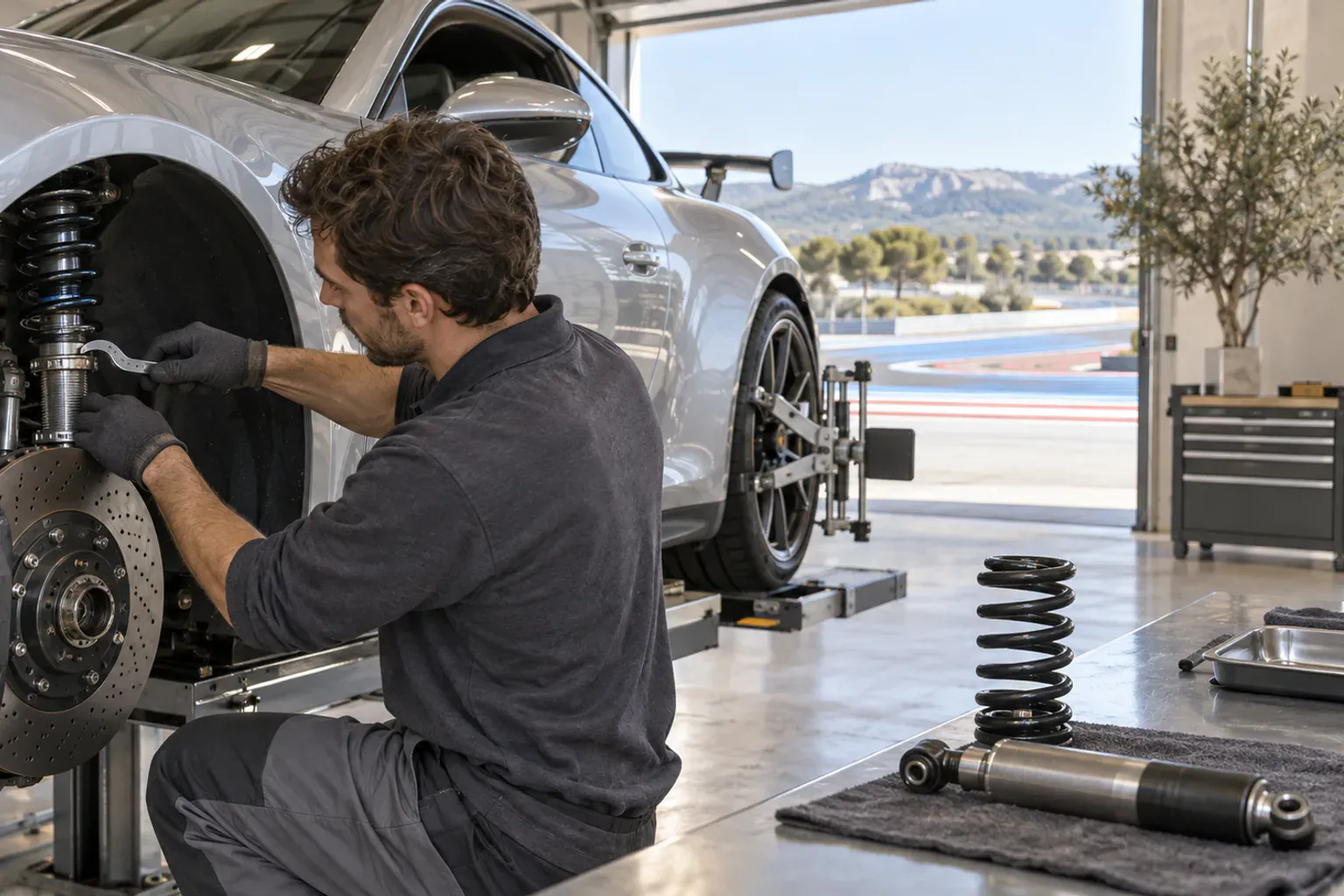
Coilovers:how they work, setup and the right choice for a road and track sports car
- 12 min read
Ride height, rebound, compression, preload, alignment: what really matters on coilovers, and why they are only as good as their setup.
Coilovers combine damper and spring with a threaded body to adjust ride height and often damping. Unlike lowering springs, they work as a coherent set suited to the use. Lower and stiffer is not faster. After fitting, alignment and road then track testing are essential.
Why a tuned sports car is decided at the chassis as much as the engine
Power gained from a remap is useless if the car cannot put it down.
In the workshop we often see tuned cars that stop progressing on track because of the chassis, not the engine.
This article explains coilovers the way we reason before advising. See also our page on suspension setup and adjustable dampers.

What are coilovers?
A coilover combines damper and spring with a threaded body for height adjustment.
Anatomy: threaded body, collars, spring, top mounts
Threaded collars set the spring seat and ride height; better designs adjust the body itself to keep full stroke.
Top mounts are fixed or camber-adjustable on spherical bearings, more precise but noisier.
Coilovers, lowering springs, factory adaptive damping
Lowering springs make the stock damper work outside its range.
Adaptive damping is versatile but offers no height or track-specific tuning.
Height only, 1-way, 2-way, 3-way
The number of ways is the number of separately adjustable damping parameters.
Ride height
Fixed damping, fine for road lowering.
One knob
Combined damping adjustment for spirited road use.
Rebound and compression
Real setup for road and track days.
Low and high speed
For intensive circuit use.
More ways means more levers, not a faster car.
What coilovers bring (and what they don't)
Weight transfer, roll, turn-in response
Good damping controls the speed and amplitude of weight transfer.
The car takes a set faster and flows between corners.
Common myths
“Lower = faster”
Too low ruins geometry and hits the bump stops.
“Stiffer = better”
Too stiff bounces and loses grip.
Daily comfort: a realistic compromise
Firmer than stock, but a well-set coilover is not harsh.
We always start from real use, as with the Porsche 911 Carrera 4 we look after.

Key settings explained simply
Understanding each lever avoids most mistakes.
Ride height and corner weights
Set height with the threaded body, never with spring preload.
Rebound and compression: one click at a time
Change one parameter at a time and note everything.
Spring rate: weight, tyres, use
Match the rate to real corner weight and tyres.
Alignment after fitting
Camber, toe and caster must be reset after every fitting.
Alignment is often part of a complete chassis preparation.

Road, track day or intensive circuit: which coilover for which use?
The right coilover matches how the car is really driven.
Spirited road with a few track days
A good 1-way or 2-way with two noted settings.
Regular track days at Le Castellet
The Mistral straight and fast corners demand stability and a flat car.
Special cases: adaptive suspension
AMG, BMW M and GT-R R35 need the electronics handled to avoid warnings.
See our track day preparation and Paul Ricard track support, plus our article preparing your car for a track day at Le Castellet.
Coilovers and a coherent build
Chassis, brakes and tyres
Anti-roll bars and tyres work with the suspension.
Brakes complete the trio: high-performance braking.
Coilovers and engine stages
More torque often makes the stock chassis the limit.
See the difference between stage 1, 2 and 3 .
Roadworthiness test and insurance
Declare suspension changes to your insurer and keep the car test-compliant.
For the legal framework, read is engine remapping legal?.

Common mistakes seen in the workshop
- 01
No alignment after fitting
Pulling and uneven tyre wear.
- 02
Settings left “in the middle”
Factory settings are only a starting point.
- 03
Too low
Bump stops, bottoming and poor geometry.
Coilover maintenance
Threads seize without basic care.
- 01
- ThreadsClean and apply anti-seize.
- 02
- LeaksCheck damper bodies for oil.
- 03
- ServiceRebuild dampers at regular intervals.
- 04
- After seasonCheck heights, torque and alignment.
Dampers fade slowly; regular checks prevent the drift.
Frequently asked questions
Are coilovers uncomfortable for daily use?
Not if well chosen and set up for the road.
Is alignment needed after fitting?
Yes, every time.
Can coilovers be fitted to a car with adaptive suspension?
Usually yes, with the electronics handled case by case.
How often should coilovers be serviced?
Yearly checks on the road, more often with track use.
Coilovers or lowering springs for mixed use?
Coilovers, as spring and damper are designed together.
A coilover is only as good as its setup
Choice, fitting, alignment and patient setup make the difference.
Bernis Factory, in Signes, 700 m from Circuit Paul Ricard, sets up suspensions on road then on track.
Let's talk about your chassis, book a workshop visit
A call or message is enough to review your car and goals.
Chassis, track and preparation
Related services and articles.
A project,
a call.
Tell us about your car and how you use it. We'll figure out the right service together, maintenance, engine tuning, chassis, restoration.
83870 Signes
Across from the Paul Ricard circuit
Monday, Friday · 9:30-18:00
By appointment only